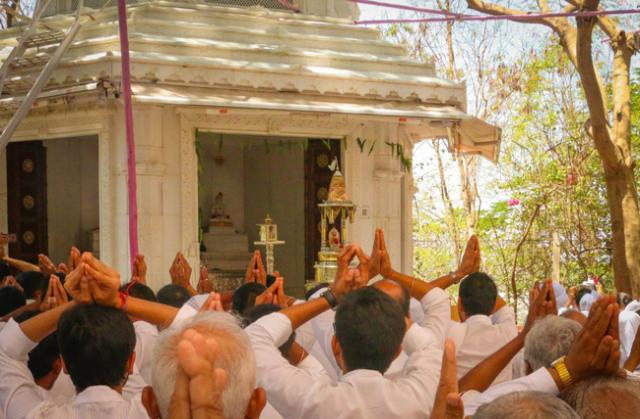
God in Jainism represents a revolutionary departure from traditional theistic religions. Unlike Christianity, Islam, or Hinduism, Jainism does not recognize a creator God who orchestrates the universe or determines human destiny. Instead, Jain philosophy posits that the universe is eternal, self-sustaining, and governed by immutable natural laws rather than divine intervention. This fundamental principle positions Jainism as a unique spiritual system where divinity is not external but intrinsic to every being.
In Jain Dharma, “God” refers to a Paramatma, a liberated soul that has achieved perfect knowledge (Kevaljnana), infinite perception (Ananta Darshan), limitless power (Ananta Virya), and eternal bliss (Ananta Sukh) after completely shedding all karmic bondage. This state represents the highest spiritual achievement, accessible to any soul through proper spiritual practice. The concept emphasizes that divinity is a natural state of consciousness rather than a supernatural status granted by an omnipotent force.
The Tirthankaras, particularly Lord Mahavira, the last Tirthankara, embody this concept perfectly. Their significance in Jain Religion lies not in their ability to create or destroy, but in their demonstration that liberation is achievable for all souls willing to follow the right path.
The Soul (Jiva): The True Essence of Being
At the core of understanding God in Jainism is the concept of Jiva, or the individual soul. Jain philosophy teaches that every soul possesses infinite knowledge, infinite perception, infinite power, and infinite bliss as inherent, eternal qualities. These divine attributes are not absent but merely obscured by layers of karmic matter that accumulate through our actions and attachments across multiple lifetimes.
The Jain worldview embraces absolute dualism, distinguishing between soul as conscious, sentient energy and matter as inert, unconscious substance. This clear demarcation is crucial because it establishes that the potential for divinity already exists within us. Our spiritual journey in Jainism is fundamentally about unveiling what already exists rather than acquiring something new.
The ultimate goal of Jain spiritual practice is to progressively remove karmic obstructions through the practice of the Three Jewels: right faith, right knowledge, and right conduct. When all karmic bonds dissolve, the soul naturally rises to its authentic state of divinity, experiencing omniscience and eternal peace. This emphasizes that liberation is not grace from above but the natural consequence of spiritual effort and moral living.
Tirthankaras: Human Beings Who Attained Godhood
A cornerstone of Jain Dharm is the concept of Tirthankaras, enlightened beings who have conquered the cycle of birth and death. The word “Tirthankara” literally means “ford-maker,” referring to these beings who create a path across the ocean of worldly existence.
According to Jain tradition, there have been 24 Tirthankaras in the current time cycle. Rushabhanath, the first Tirthankara, initiated human civilization and the spiritual path, while Lord Mahavira, the 24th and final Tirthankara, lived historically around the 6th century BCE and revitalized Jainism in his lifetime. These are not gods in the conventional sense, but rather perfected human souls who achieved the highest spiritual state through their own endeavor.
The reverence shown to Tirthankaras in Jain Religion is unique, they are worshipped not as creators or saviors with supernatural powers, but as perfect beings worthy of emulation and respect. Their teachings and example provide the blueprint for spiritual ascension, making them the most important guides in Jainism. By studying their lives and following their principles, followers of Jainism walk the proven path to liberation.
The Three Jewels: The Path to Liberation and Divinity
The pathway to becoming achieving divinity in Jainism is clearly outlined through the Three Jewels. Right Faith involves unwavering belief in the teachings of the Tirthankaras and understanding the true nature of the soul as inherently divine. This is not blind faith but rational belief grounded in philosophical reasoning.
Right Knowledge represents accurate, comprehensive understanding of Jain philosophical principles, including the nature of matter, soul, and the laws governing karma and liberation. This knowledge must be experiential, not merely intellectual, penetrating one’s consciousness and transforming one’s worldview.
Right Conduct is the practical manifestation of faith and knowledge through adherence to the Five Great Vows: Ahimsa, Satya, Asteya, Brahmacharya, and Aparigraha. Through consistent practice of these vows, a soul progressively purifies itself of karmic matter.
The empowering message of Jain Dharm is that every individual, through personal effort and spiritual discipline, can achieve the state of divinity. There is no external savior, no divine intermediary, liberation is self-earned, making each soul the architect of its own spiritual destiny.
Worship and Devotion in Jainism: The Meaning Behind the Rituals
Worship in Jain Religion serves a distinctly different purpose than in theistic religions. Puja is not about appeasing an all-powerful god or requesting favors from a divine being. Instead, it is about venerating the qualities of enlightened and liberated souls, using their perfection as inspiration for our own spiritual journey.
Common forms of worship include Darshan , Puja involving symbolic offerings of water, rice, flowers, and incense as representations of purification and detachment, and chanting the Namokar Mantra, the supreme mantra of Jainism that salutes all perfected souls without distinguishing between different deities.
This approach to worship in Jainism cultivates reverence, discipline, and spiritual aspiration while maintaining philosophical consistency with the belief that divinity is achieved through individual effort rather than external grace.
Frequently Asked Questions (FAQs)
1. Does Jainism believe in God?
Jainism does not believe in a creator God but recognizes Paramatma, liberated souls with infinite knowledge and bliss. Every soul has potential for divinity through karmic purification and spiritual practice.
2. Who are the Tirthankaras in Jainism?
Tirthankaras are 24 enlightened beings who attained liberation and established the Jain spiritual path. Lord Mahavira was the last Tirthankara, living around the 6th century BCE, guiding souls toward salvation.
3. What are the Three Jewels in Jainism?
The Three Jewels are Right Faith, Right Knowledge, and Right Conduct.They form the complete spiritual path enabling souls to remove karmic bondage and achieve the divine state of liberation.
4. How do Jains worship without believing in God?
Jain worship venerates the qualities of perfected souls through Puja, Darshan, and mantra chanting. This inspires spiritual practice rather than seeking divine intervention or favors from an external deity.
5. Can ordinary people achieve divinity in Jainism?
Yes, Jainism teaches that every soul inherently possesses infinite knowledge obscured by karma. Through disciplined practice of the Three Jewels and Five Vows, any individual can progressively achieve liberation.