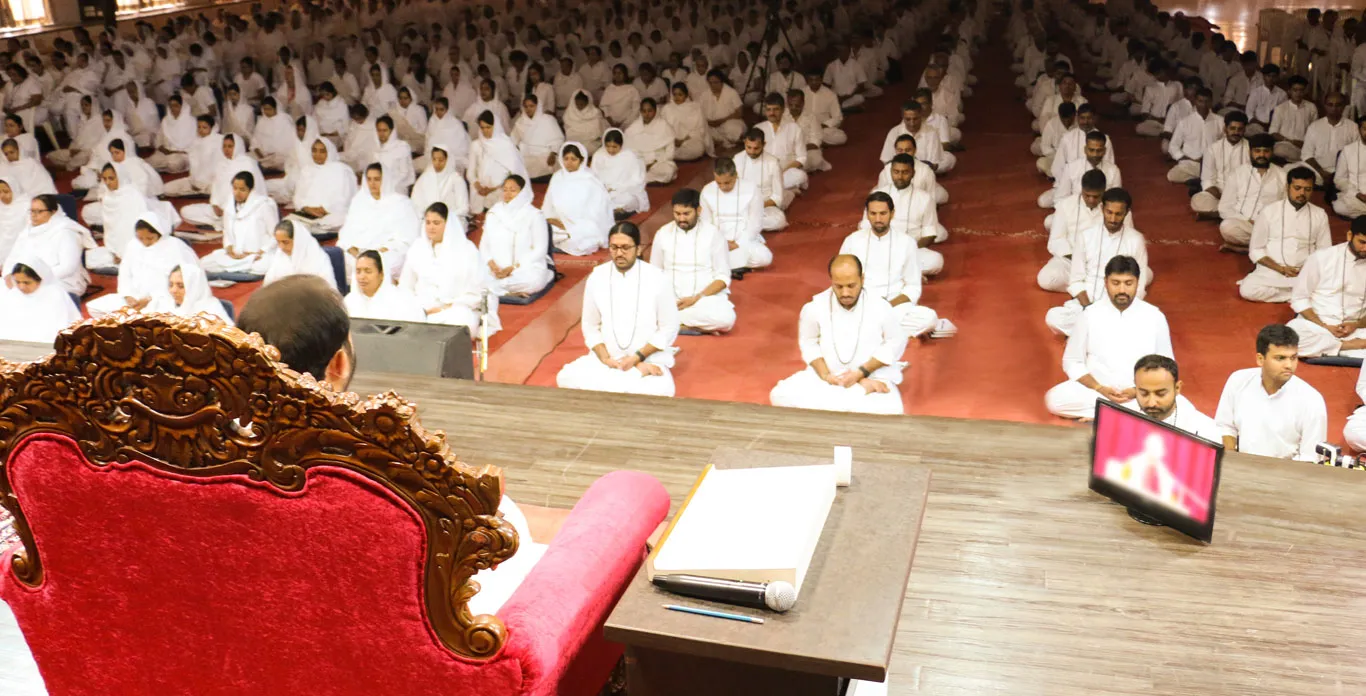
A Sadhana Bhatti at Shrimad Rajchandra Mission Dharampur is a structured period of spiritual practice that brings together meditation, silence, reflection and guidance.. In our experience at the Ashram, what stands out most is not any external change in environment, but the gradual clarity participants begin to see within themselves.
The schedule is simple and disciplined. Days are organised around meditation sessions, discourses, reflection time and periods of silence. The setting of the Ashram supports this practice naturally, allowing attention to turn inward with fewer distractions.
Awareness of the mind as it is
One of the first observations participants make is how active the mind remains even in silence. Thoughts continue to arise without interruption. Planning, remembering, anticipating and revisiting situations all appear in their natural flow.
This observation is central to the practice at Shrimad Rajchandra Mission Dharampur. The intention is not to change the mind immediately, but to understand its movement. Over time, there is a clearer recognition of how often attention is carried by thought without conscious choice.
Within the structure of spiritual retreats in India, this form of observation becomes more apparent because external stimulation is intentionally reduced.
Distinction between awareness and thought
As the practice continues, there is a gradual understanding that thoughts are being observed. This simple recognition brings a shift in perspective.
The content of thought may continue as before, but awareness begins to feel distinct from it. Participants often describe a growing sense of space around their experience. This clarity is supported through guided meditation and teachings shared during the Sadhana Bhatti.
The emphasis remains on steady practice rather than intellectual interpretation. The experience unfolds through observation.
Understanding emotional responses
Emotional reactions are part of daily life and continue to arise during the retreat. However, the structured environment provides time to notice them without immediate expression or external reaction.
This allows participants to observe how emotions rise, peak and settle. Anger, restlessness, sadness and joy are seen as passing states rather than fixed conditions.
This observation is supported through principles of non-reactivity and awareness. The focus remains on understanding rather than suppression.
Simplicity in daily living
The routine of a Sadhana Bhatti is intentionally simple and sacred. Meals, rest, meditation, and discourse unfold within a clearly defined rhythm. The use of digital devices and all forms of external communication is not permitted, creating a protected space for silence, presence, and deep inward immersion throughout the sadhana.
This simplicity often brings attention to how much complexity is present in regular routines. Many participants notice that comfort does not depend on excess activity or constant engagement.
Over time, there is a natural adjustment to this rhythm. The mind begins to settle into a quieter pace without effort.
The role of attention
Attention becomes a key area of observation during the retreat. It is seen how frequently it moves from one thought to another, or from present experience to memory and anticipation.
Through some guided meditation practices, attention is gently brought back to a chosen focus. This repeated process develops steadiness.
Observing habitual patterns
As silence continues over multiple sessions, habitual patterns become more visible. These may include repeated thought loops, emotional reactions or internal conversations.
The retreat environment does not aim to remove these patterns. Instead, it allows them to be seen clearly. This recognition itself becomes meaningful for participants.
In many cases, this is one of the key insights gained during Indian spiritual retreats, where reduced external activity highlights internal tendencies.
Experience of stillness in practice
Moments of stillness arise naturally during meditation sessions. These are not forced experiences, but outcomes of sustained practice and guided focus.
In these moments, there is a sense of ease and reduced mental activity. Even when thoughts are present, they do not dominate attention in the same way.
Such experiences are part of the gradual process of Sadhana Bhatti and are supported through consistent daily structure and guidance.
Recognition of automatic living
Another important understanding that emerges is how much of daily behaviour operates through habit. Responses, decisions and reactions often follow familiar patterns without conscious awareness.
During the retreat, this becomes easier to notice. With fewer external demands, there is more space to observe how actions arise.
This recognition is not meant to create judgment. It serves as an opportunity to understand oneself with greater clarity.
Gradual inner steadiness
As the Sadhana Bhatti progresses, participants often notice a shift in how they relate to their own experience. Thoughts and emotions continue as part of normal functioning, yet there is a greater sense of steadiness in observing them.
This steadiness is not presented as a final outcome. It is part of an ongoing process of practice and reflection encouraged at Shrimad Rajchandra Mission Dharampur.
Closing reflection
A Sadhana Bhatti offers structured time away from external engagement and supports a return to simple awareness. The learning that emerges is gradual and personal.
Participants often leave with a clearer understanding of how their mind functions, how attention moves, and how habits influence daily experience. This clarity becomes a foundation for continued practice beyond the retreat setting.